8th-grade math · for students 13+

Math you do, not math you watch. Solve for x.

GamEdu turns 8th-grade math into short missions your teen plays in the browser. They balance equations, move shapes and plot real data. No leaderboards, and no comparing one student with another.

Invite-only alpha. For students aged 13 and over. Parents request access.

Try one moveOperation Linear
Goal: find the weight of one box, x. Keep the scale balanced: whatever you do to one side, do to the other.
3x + 5 20

3x + 5 = 20

A simplified example of a GamEdu mission.

How it works

Every class is a briefing, then a mission

A class takes about 10 minutes, so a teen can finish one in a sitting and pick up the next one later.

  1. 01 · Briefing

    Learn the idea

    Each class opens with a short briefing that teaches one idea, like dividing both sides of an equation.

  2. 02 · Mission

    Use it hands-on

    A game makes your teen use the idea: balancing a scale, sliding and reflecting shapes, fitting a trend line to data.

  3. 03 · Feedback

    Learn from every move

    A wrong move comes with an explanation of why. Progress saves, and “Continue” picks up where they left off.

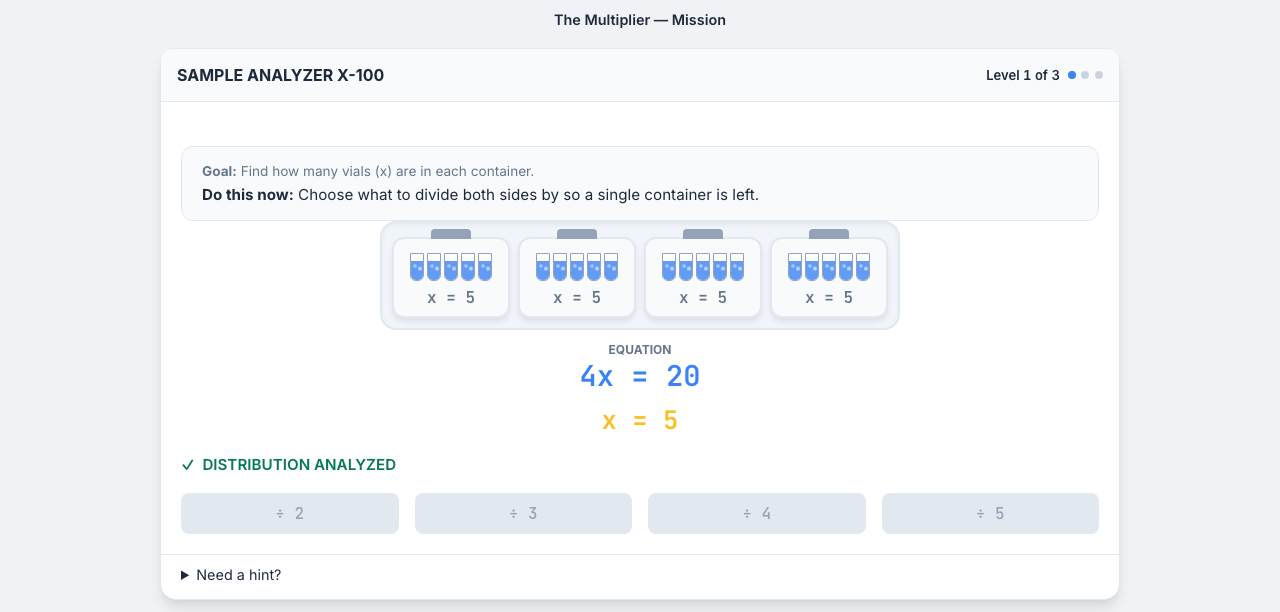
A GamEdu mission: four containers of vials model the equation 4x = 20, solved as x = 5.
A mission from Operation Linear: dividing both sides to find x.
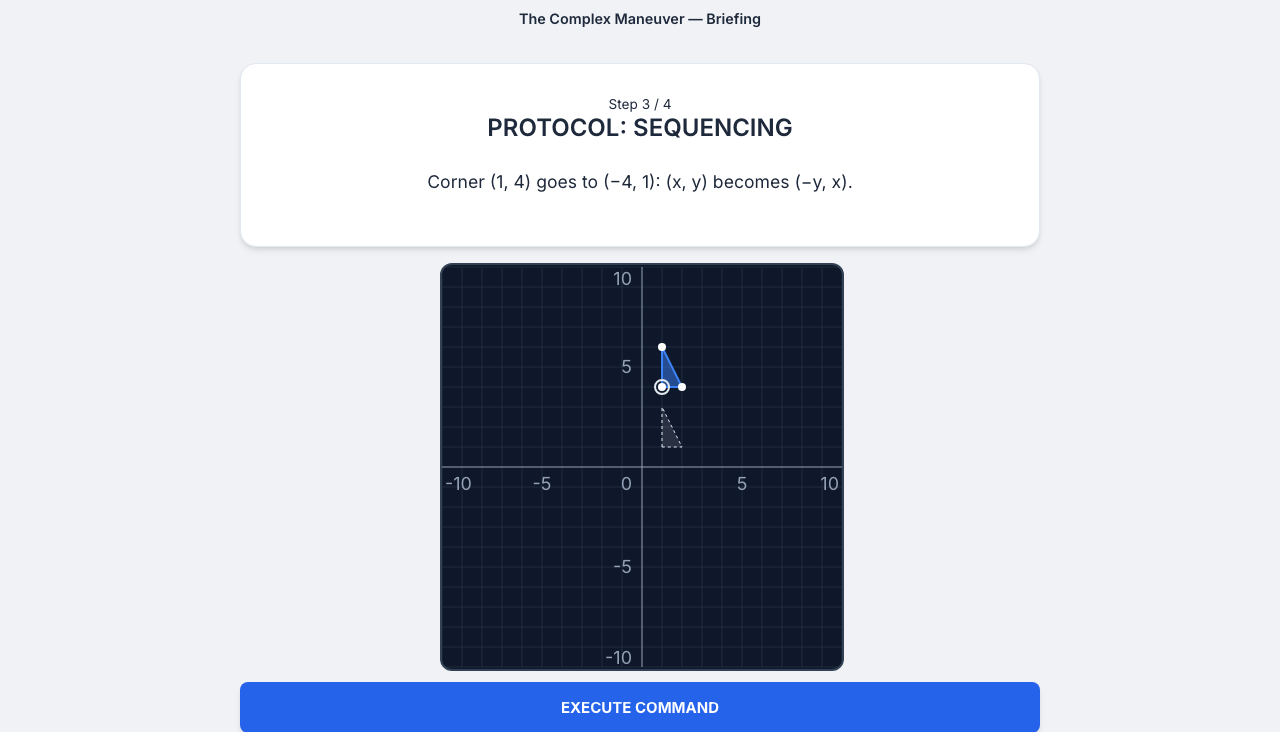
A GamEdu briefing on rotations: a triangle is turned on a coordinate grid, where (x, y) becomes (−y, x).
A briefing on rotations, drawn on a coordinate grid.

Why parents choose it

Hands-on, calm, and it explains the why

Learning by doing

Your teen works the math with their hands: moving, balancing and plotting, not picking A, B or C.

Progress is personal

Stars show how well a mission went, for your teen alone. We left these out on purpose, so progress is about understanding, not pressure.

leaderboardsclass rankings

The why, every time

Mistakes come with reasons. A wrong move shows what happened to the equation and what to try instead.

What's inside

Three divisions, nine operations, 61 classes

Students play as agents in the Operations Center. Behind the story is the math of 8th grade.

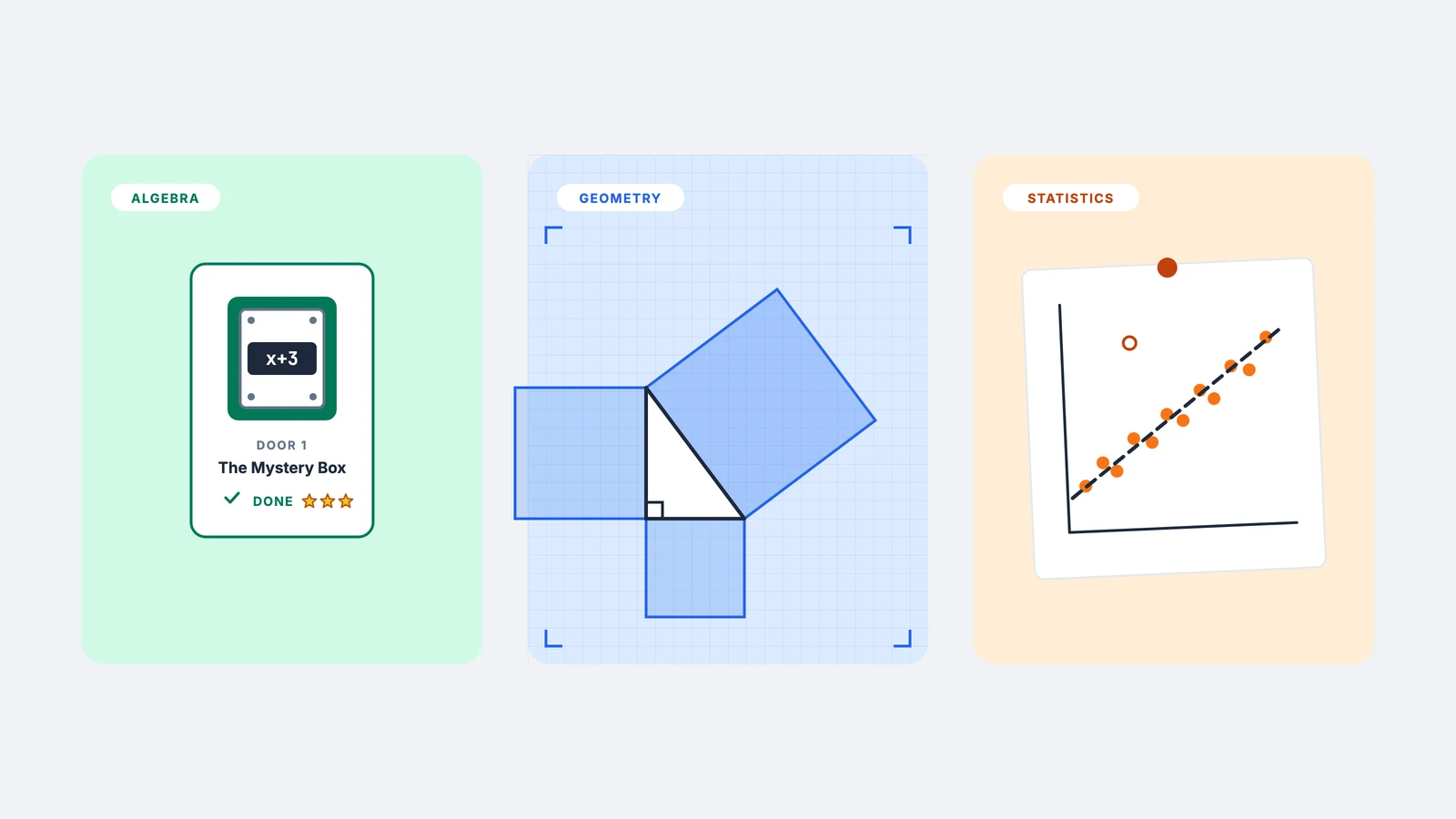
The three subjects side by side: an algebra door marked Done with three stars, a right triangle with squares on its sides, and a scatter plot with a trend line.
Cyber Command

Algebra

28 classes
  • Operation LinearLinear equations, one step to variables on both sides
  • Operation FunctionInputs, rules and outputs; slope-intercept form
  • The NetworkSystems of equations: graphing, substitution, elimination
  • Quantum CryptographyExponent rules, roots and scientific notation
Engineering Corp

Geometry and number

20 classes
  • The CartographersTranslations, reflections, rotations, dilations; congruence and similarity
  • The ArchitectsThe Pythagorean theorem, distance, volume of cylinders, cones and spheres
  • The NavigatorRational and irrational numbers, parallel lines, triangle angle sums
Intel Division

Statistics

13 classes
  • The AnalystsScatter plots, lines of best fit, outliers, two-way tables
  • The ArchiveCenter and spread, dot plots, histograms and box plots

Works where your teen is

Phone, tablet or laptop. Nothing to install.

  • Runs in the browser on any recent phone, tablet or computer.
  • Progress saves to your teen's account, so they can switch devices.
  • Built with readability in mind: color-contrast checks, keyboard support, and layouts tested on every screen size.
  • In English for now.
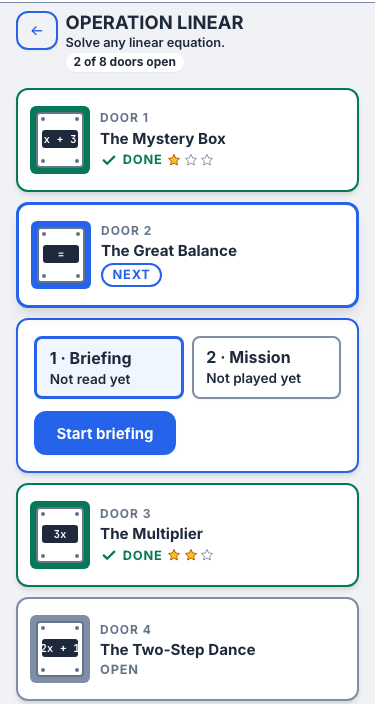
GamEdu on a phone: the Operation Linear map, with finished doors marked Done and the next one marked Next.
Invite-only alpha

Where we are

GamEdu is in an invite-only alpha. We're working closely with a small group of families to shape what comes next, and we're starting with 8th-grade math.

Who's building it? A small team with backgrounds in mathematics research and software product development.

Teach 8th grade? Ask us about trying it with your class:

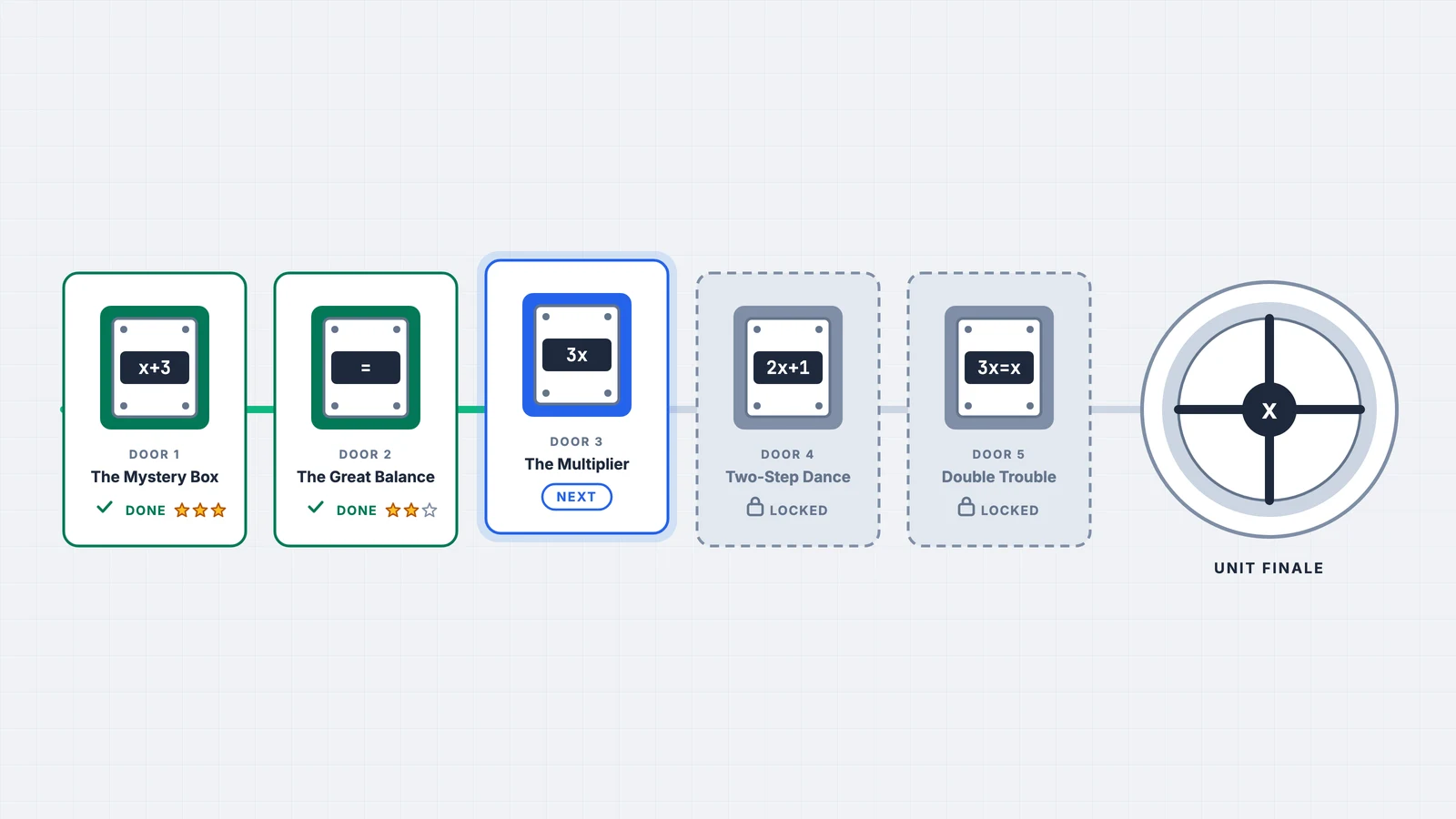
A unit map drawn as a corridor of doors: two done with stars, the next one marked Next, the rest locked, ending at the unit finale.

Request an invite

Ready for the first mission?

Tell us a little about your family. We invite families in small groups and email you when a place opens.

  • For students aged 13 and over
  • A parent requests access, not the student
  • We never ask for your child's name or email here
What would you like?

We use your details only to handle your request and, if you tick the box, to send news. You can ask us to delete them at any time. Read the privacy notice.

Questions

What parents ask us

Who is it for?

Students aged 13 and over working on 8th-grade math. A parent requests access.

Is it free?

Yes. The alpha is free.

How much time does it take?

A class takes about 10 minutes. Your teen can do one a day or a few in a row. Progress saves, so they can stop anytime.

What happens after I request an invite?

We invite families in small groups and email you when a place opens, with everything your teen needs to start.

Is it in Hebrew?

Not yet. The course is in English for now.

Does it follow the school curriculum?

It covers core 8th-grade topics, listed above. We haven't published a formal mapping to any curriculum.

Does it improve grades?

We haven't measured that, and we won't claim it until we have. Learning what works for families is what the alpha is for.

Why no leaderboards?

They reward speed and comparison. We want progress to mean understanding, so your teen never sees how they rank against others. Stars show how well a mission went, and nothing is ever taken away.

What data do you collect?

What you type into the form and, only if you accept analytics cookies, how visitors use this site (via Google Analytics). Read the privacy notice for the details.